


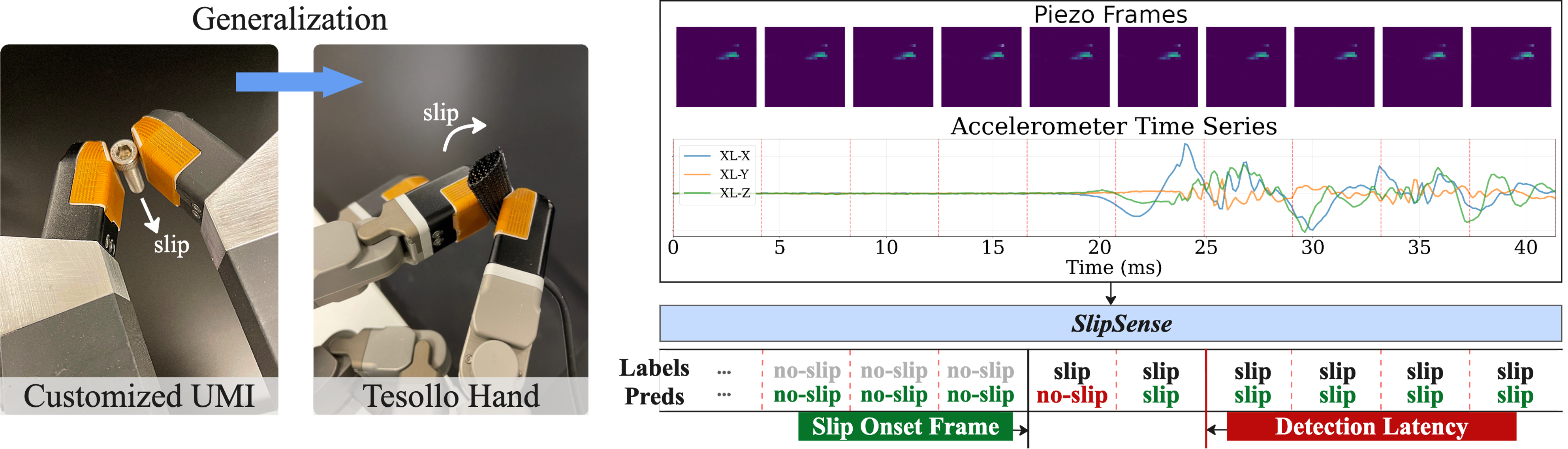
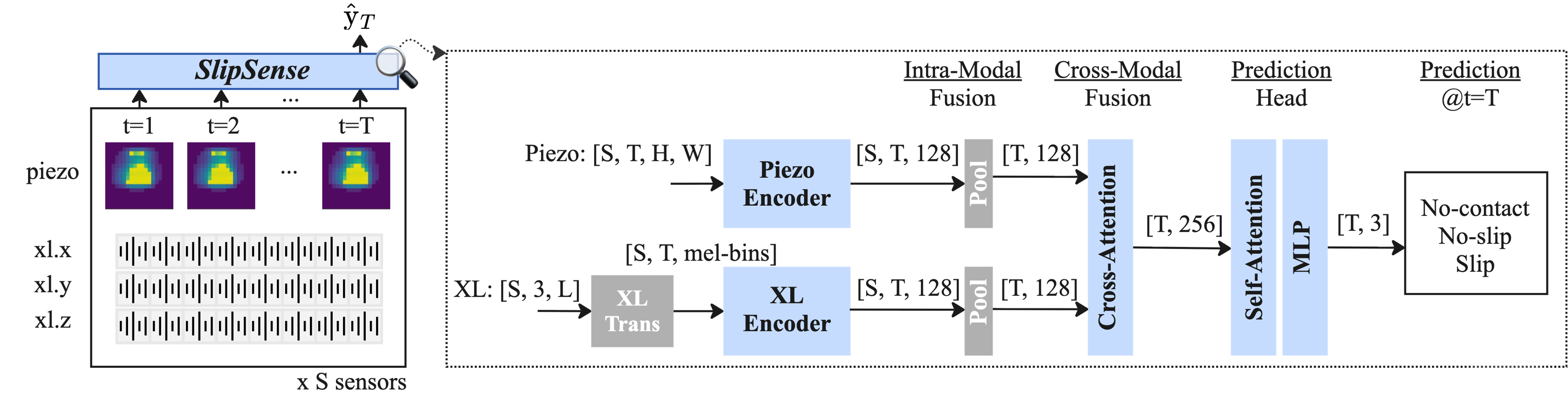
Slip detection is fundamental to dexterous manipulation, yet existing systems often lack precise detection latency characterization and cross-platform generalization. We present SlipSense, a multimodal tactile slip detection framework built on TacV5, a compact sensor integrating a 32×32 piezoresistive array (240 Hz) and a 3-axis MEMS accelerometer (8 kHz). The piezoresistive array captures spatial pressure distribution while the accelerometer captures friction-induced vibration, providing complementary slip cues. The framework performs modality-specific encoding, intra-sensor fusion, and cross-modal attention with causal temporal prediction at 240 Hz.
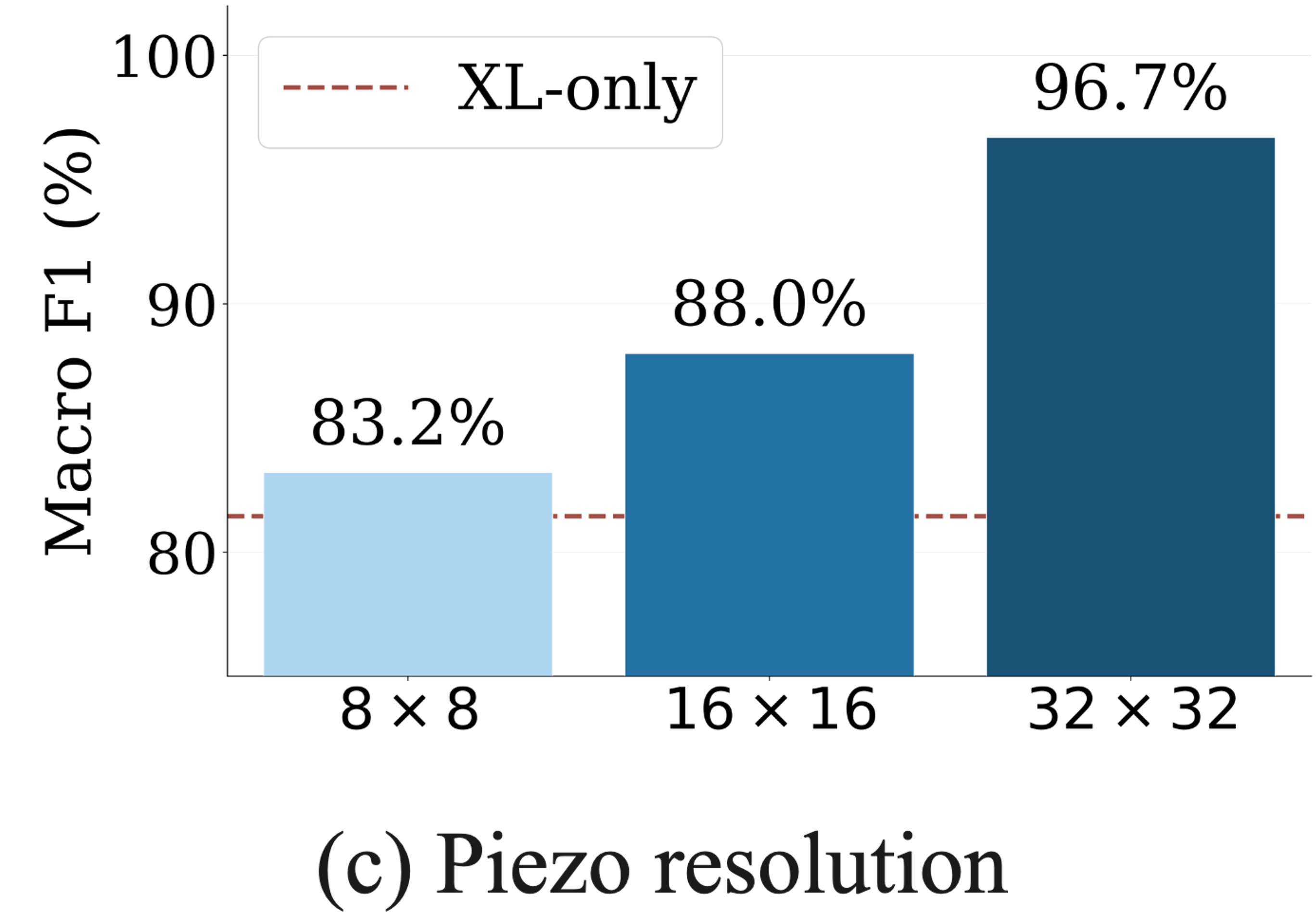
Experiments on a 1.4M-frame dataset spanning 37 objects demonstrate that the two modalities are crucially complementary: it achieves 96.7% Macro F1 with false-positive rate below 1.6%, detecting 76% of slip events within 23.1 ms. Remarkably, trained purely on a UMI, SlipSense generalizes zero-shot to a Tesollo dexterous hand, transferring across unseen objects, distinct sensor units and new robotic platforms without any retraining.
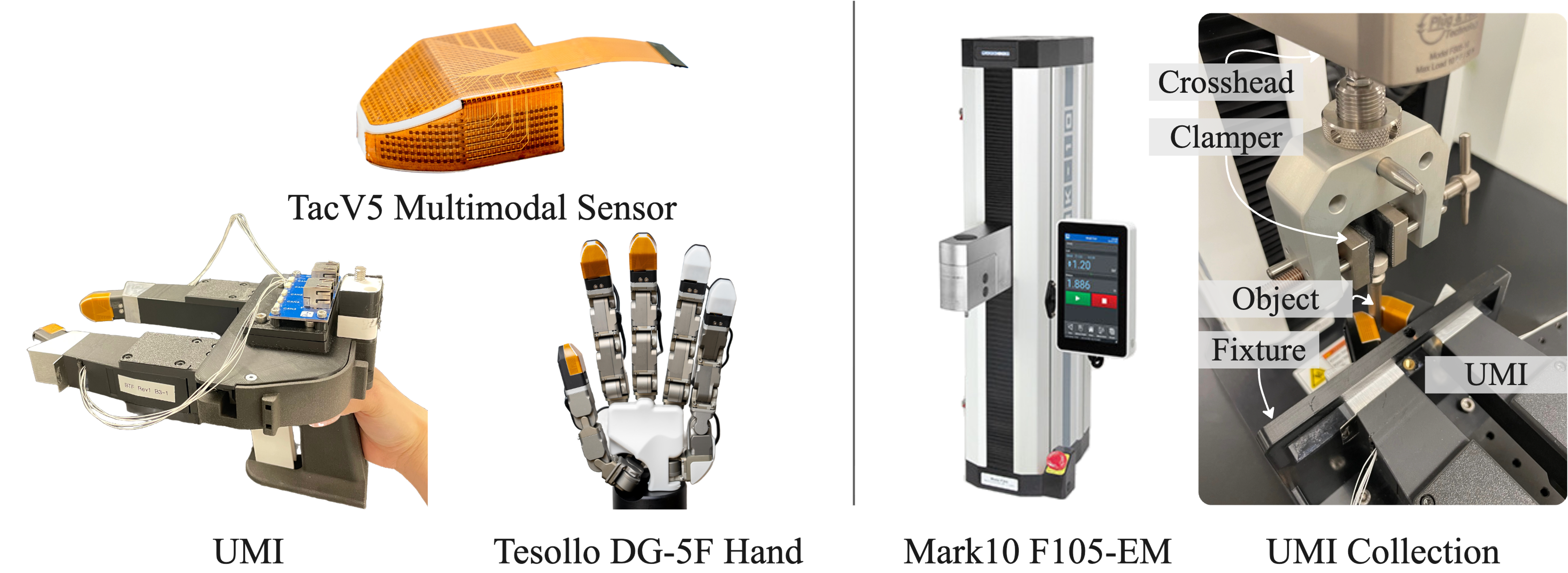
TacV5 integrates a high-density 32×32 piezoresistive array (Piezo) with a 3-axis MEMS accelerometer (XL) in a compact fingertip form factor. Piezo captures spatial normal pressure distribution at 240 Hz with ~1.55 taxels/mm², while XL captures friction-induced vibration at 8 kHz. We evaluate on two platforms: a customized UMI parallel-jaw gripper and a Tesollo DG-5F 20-DoF dexterous hand.
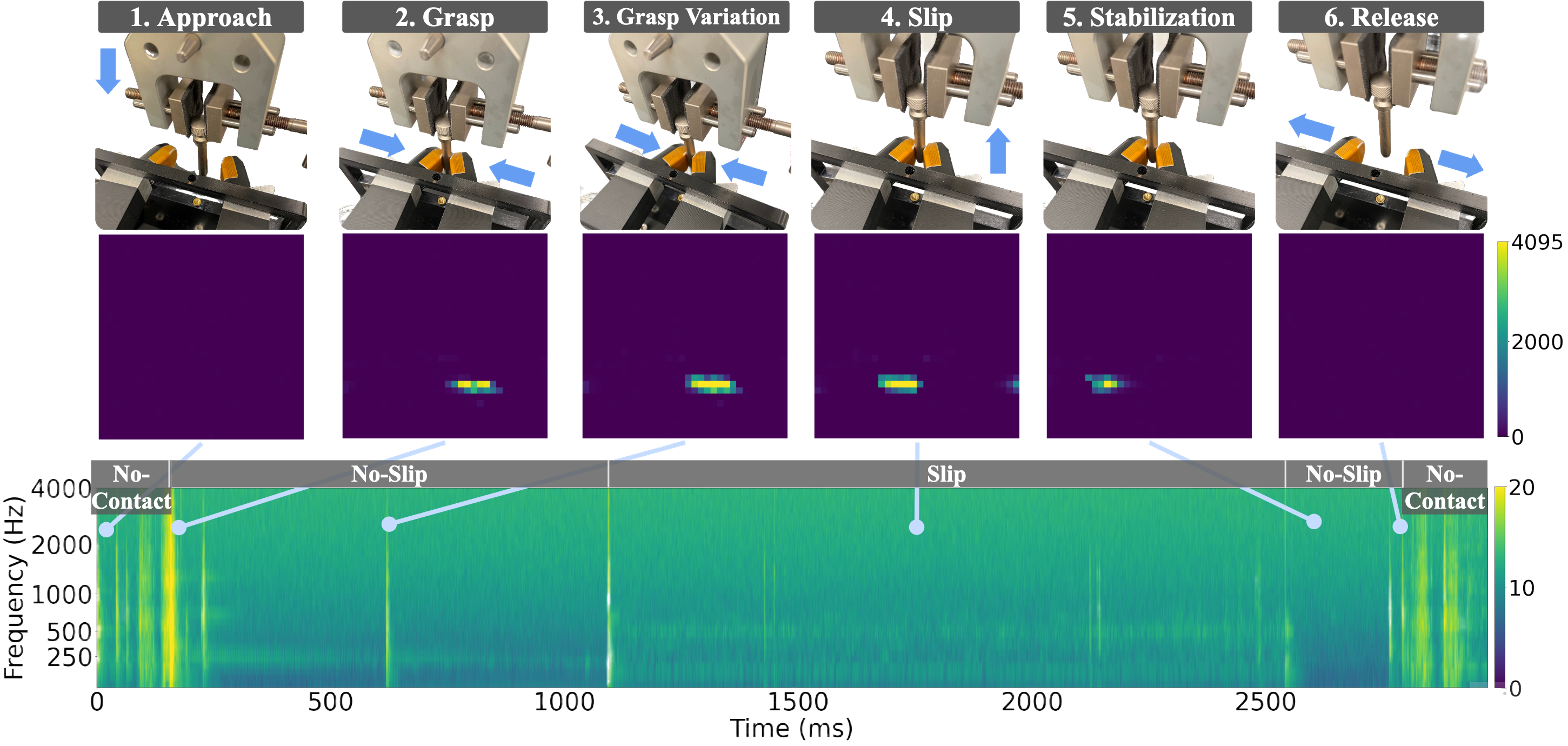
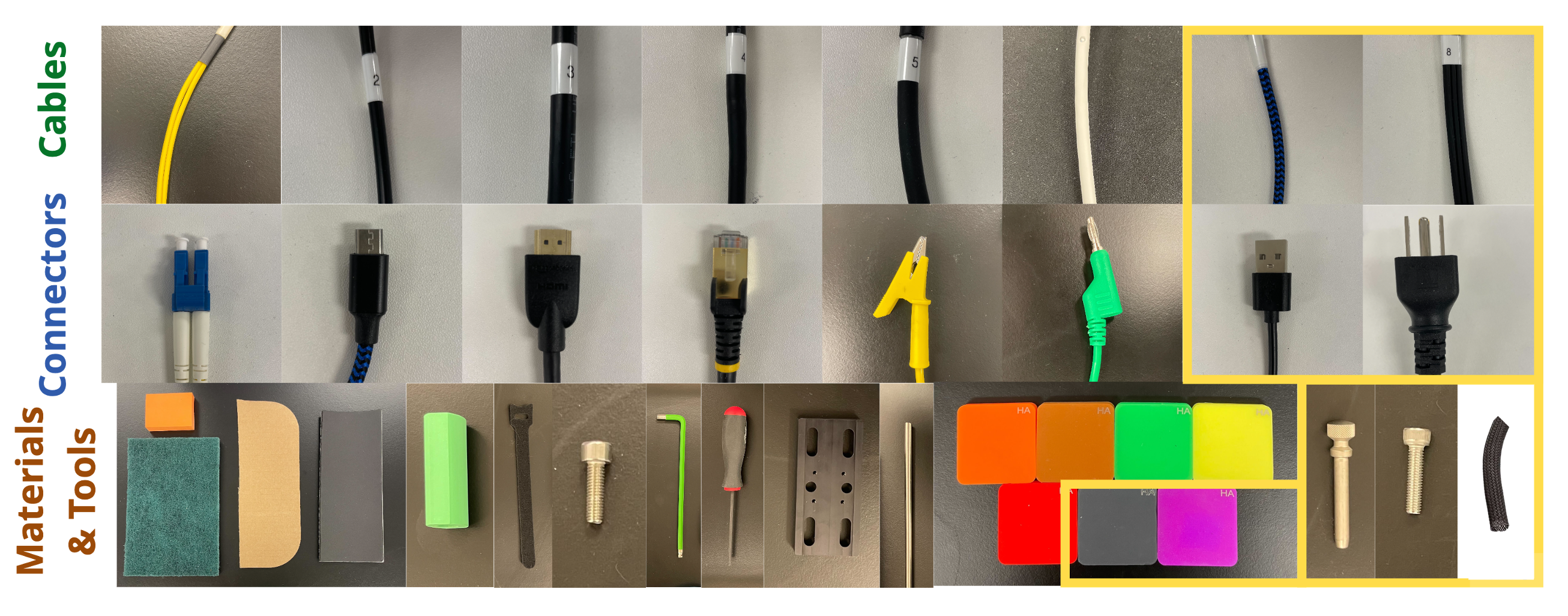
A single trial proceeds through six phases: approach, grasp, grasp variation, slip, stabilization, and release. The Piezo heatmaps show spatial pressure evolution while the XL spectrogram reveals friction-induced vibration transients at slip onset. Together they provide complementary cues that neither modality captures alone. We collect a 1.4M-frame dataset spanning 37 objects.
Piezo frames and XL spectrograms are encoded by dedicated backbones, pooled across sensors for variable-cardinality input, fused via cross-modal attention, and passed through a causal temporal classifier that predicts ternary state (no-contact, no-slip, slip) at every frame.
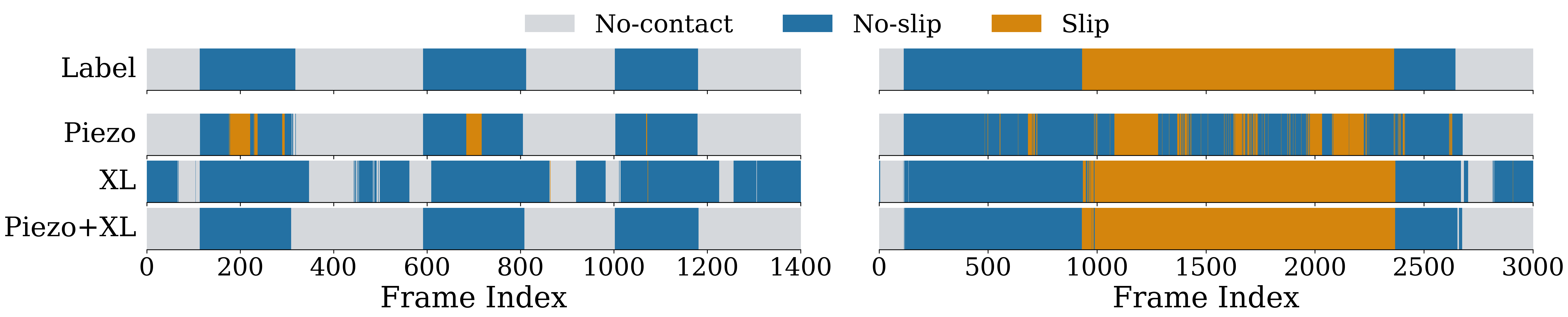
| Method | Piezo | XL | UMI ID | UMI OOD | ||||||
|---|---|---|---|---|---|---|---|---|---|---|
| Lat (fr)↓ | FPR (%)↓ | Acc (%)↑ | F1 (%)↑ | Lat (fr)↓ | FPR (%)↓ | Acc (%)↑ | F1 (%)↑ | |||
| Baselines | ✓ | 1.00 | 21.69 | 72.87 | 74.51 | 2.00 | 21.08 | 73.84 | 75.29 | |
| ✓ | 1.00 | 22.98 | 79.41 | 81.79 | 2.00 | 19.31 | 82.99 | 84.55 | ||
| ✓ | ✓ | 1.00 | 9.28 | 81.16 | 79.96 | 2.00 | 7.40 | 83.33 | 82.18 | |
| SlipSense | ✓ | 20.50 | 7.54 | 84.63 | 83.54 | 36.17 | 8.43 | 82.69 | 81.91 | |
| ✓ | 4.67 | 2.14 | 84.21 | 81.61 | 3.00 | 3.24 | 84.74 | 81.33 | ||
| ✓ | ✓ | 2.00 | 1.33 | 96.98 | 96.77 | 1.50 | 1.57 | 95.99 | 95.75 | |
Higher spatial density captures finer contact patterns that lower resolutions miss entirely.
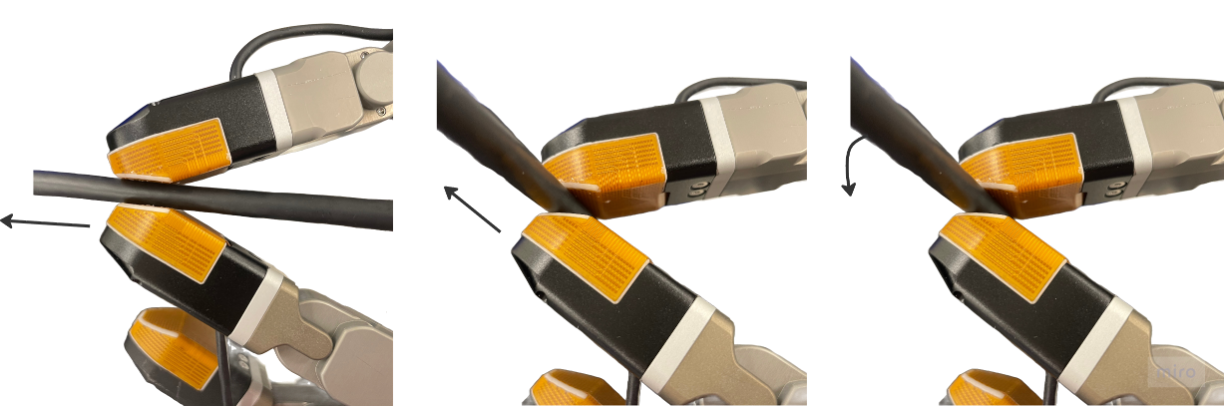
Trained on UMI linear slip, SlipSense transfers zero-shot to the Tesollo dexterous hand — over unseen articulation geometry and unseen system dynamics — achieving 100/100 detection and 95/100 closed-loop prevention.
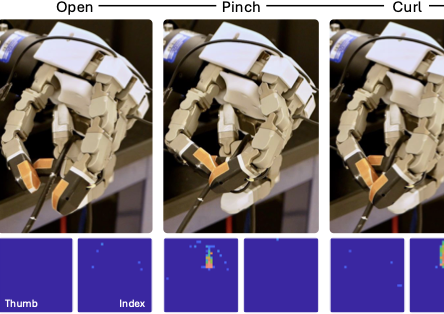
Touch2Trace: Tactile Sensing for Dexterous Manipulation
Conference on Robot Learning (CoRL), 2026
How does the same tactile sensor contribute to downstream dexterous manipulation tasks?
Reference
SlipSense: Multimodal Tactile Learning for Low-Latency and Generalized Slip Detection
@inproceedings{slipsense2026,
  title     = {SlipSense: Multimodal Tactile Learning for
               Low-Latency and Generalized Slip Detection},
  author    = {Tong Jian and Aditya Thurvas Senthil Kumar
               and Xinyi Li and Ziling Chen and Tianyu Dai
               and Ali Sengul and Matteo Grimaldi and Wenjie Lu
               and Saleh Nabi and Tao Yu},
  booktitle = {Conference on Robot Learning (CoRL)},
  year      = {2026},
  eprint    = {2609.15910},
  archivePrefix = {arXiv},
  primaryClass  = {cs.RO},
  url       = {https://arxiv.org/abs/2609.15910}
}